Dissolve The European Union and Save Europe
Socialism has failed. Centralized power and overregulation from Brussels have failed. Europe must recreate itself as a free trade zone between sovereign countries. Only then will it have real economic and political weight.
The European Union has failed. Its economy has fallen dramatically behind those of the US and China. EU Commission President Ursula von der Leyen is vilified today for giving in to an unfavorable trade deal with Trump, but she had no choice. Europe is not in a position to play hardball. It has become powerless. President Trump is making that brutally clear. Instead of lamenting their lost influence, Europeans should use the opportunity of this loss of face to disband Brussels' monstrous bureaucracy and start anew from scratch.
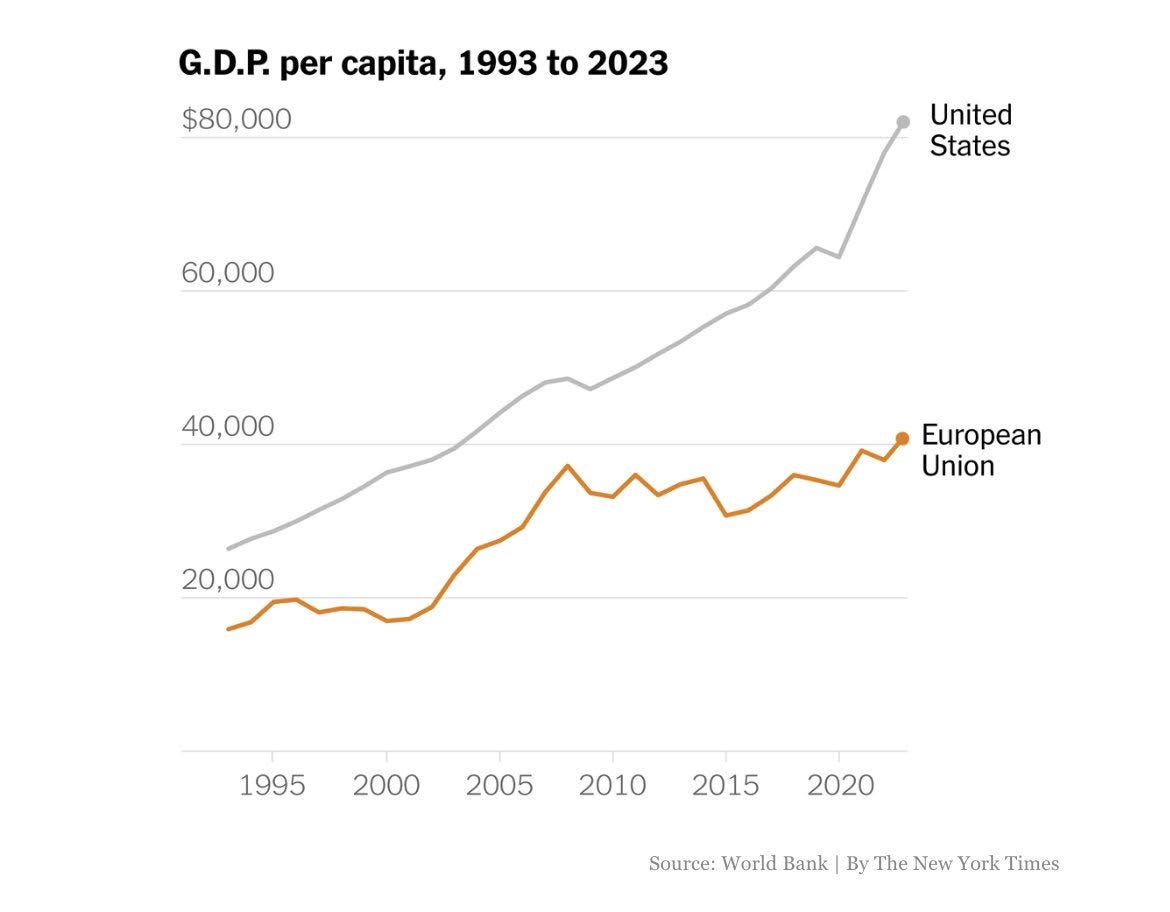
At the beginning, nearly seven decades ago, a large economic zone without borders was imagined. It seemed like a great idea. But building a new, supranational bureaucracy on top of it was never going to be the right way to go. Unfortunately, that is what happened. Weak national leaders let unelected bureaucrats hijack the European Union project.
Instead of unleashing animal spirits in a dynamic market of 450 million consumers, Eurocrats in Brussels ended up choking the economy to a standstill by over-regulating. The European Union’s biggest accomplishment to date is nothing but a heavy new layer of regulations. Call it the Brussels swamp if you like.
Europe is at a crossroads. It can't go on like this. If Europeans want the EU to become something more than a museum, they will have to finally move away from twentieth- or even nineteenth century thinking.
The size of its internal market matters of course, but size alone is not sufficient for growth. Free markets--and indeed capitalism--are also needed. By definition, socialism replaces free markets with government-run and regulated industries, which always end up choking growth and innovation.
European elites have misread history. The 1930s were characterized by the rise to power of two new political doctrines: national socialism (aka nazism or fascism) and international socialism (aka communism). World War II defeated the former and the fall of the Berlin Wall signaled the end of the latter in Europe.
In 1958, six countries joined a union with the two purposes of fighting the excesses of nationalism (i.e. war), and of creating a large economic bloc to rival the USA. Unfortunately, fighting the excesses of socialism--the common denominator of nazism and communism--was not part of the deal. More than half a century later, the number of countries involved in that union has grown to 27 and the number of bureaucrats has more than kept pace with this expansion.
The latest countries to join the EU are the Central European countries. They have a very different read of recent history. They don’t see nationalism as a problem. On the contrary, they want their sovereignty back after years of Soviet rule. Having experienced the devastation of communism under Russian imperialism, these countries want to anchor themselves as firmly as possible to the West. But they don’t want to swap Russian communist commissars for socialist Eurocrats. They’d rather embrace national capitalism, not to be confused with national socialism.
Poland, when it regained independence in 1989 chose shock therapy. Polish leaders wanted a free market economy right from the get-go, with no transition and no "third way". Willy-nilly, Poles were thrust into full-blown capitalism. Remarkably, it has served them very well indeed. Poland is the only major European country that can boast 3.7% annual GDP growth over the last 10 years. In contrast, the German economy has been at a virtual standstill, growing at a dismal 0.8% per annum. Why then would Poland want to emulate EU-style stagnation? Success brings credibility and Poland's voice for free markets, more sovereignty and less supra-national decisions in the European Union is getting louder. Alas, France and Germany still call the shots.
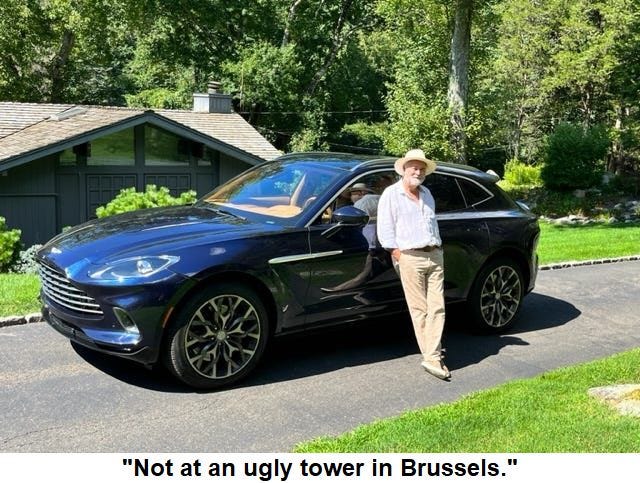
Europeans must recognize they are on the wrong path if they want to avoid entropy. Capitalism is not a dirty word. It may appear more chaotic than top-down industrial policy, but it has proven much more successful in the long run. Let market forces guide the allocation of capital. Competing choices made by self-interested entrepreneurs do better than bureaucrats' blueprints at creating what people want. The trial and error process of capitalism generated Google, Microsoft and Amazon. After all, Nvidia was born in a Denny’s restaurant, not in an ugly tower in Brussels.
Consumerism may sound crass to sophisticated Europeans, but freedom includes freedom of choice. A society can have lofty values while also desiring to accumulate wealth. Europeans seem to think these are conflicting impulses. Or could it be that criticizing capitalism and consumerism is just a way to justify and protect the coziness of a life with very little risk, responsibility and six week vacations?
Europe must unleash its potential by rekindling the spirit of the Europe 92 project. For those who have forgotten, that project was about the free flow of goods and services, people and capital within the European Union. It was not about building a temple to bureaucracy in Brussels. Dismantle the EU and rebuild from scratch. Embrace De Gaulle's vision of a Europe of sovereign nations ( l'Europe des nations) combined with Thatcher's vision of free markets.
Most observers agree the EU has failed economically. The gap between America’s and Europe’s GDPs per capita is widening every day. Socialism has failed. Centralized power and overregulation from Brussels have failed. Europe needs to wake up and smell the coffee. Stop imposing shared mediocrity and embrace inequality of outcome.
The current EU structure needs to be disbanded. Europe needs to reduce its political ambitions. Too much power has been given to the European Commission and even to the European Parliament. Europe has to recreate itself as a free trade zone between sovereign countries. Only then will it have real economic and political weight.