MOPPX Closing
The Mercator International Opportunity Fund (MOPPX, MOOPX) is closing.
The international stock markets have continued to underperform a technology-driven bull market in the US. Both economic growth and stock valuations have diverged considerably for more than a decade now. Investors are rightly attracted by American dynamism and creativity, but today’s stock market valuation brings to mind Alan Greenspan’s famous observation of irrational exuberance.
The rest of the world has been left behind. Valuations reflect the fact that people have understandably lost patience. Morgan Stanley estimates the Price Earnings Ratio for Japan at 15, France (14), the UK (12.5) or Germany (12), substantially lower than the Nasdaq (29) or even the S&P (20.5). We still believe that Overseas stocks are a prudent diversification. There is more to the economy than technology.
Trump 2.0 will change drastically the world economic order. It is too early to tell how the world will take it. The reaction in Europe, for instance, is one of consternation. Europeans may choose confrontation or accommodation to a more protectionist America. Frankly, after nearly two decades of huge underperformance, it would be suicidal to try a tit-for-tat policy. If, on the contrary, Europe embraces the new wave of deregulation and lower taxes, we could see a resurgence of its economy and its stock markets last seen in the nineteen nineties.
Performance Of The Mercator Fund
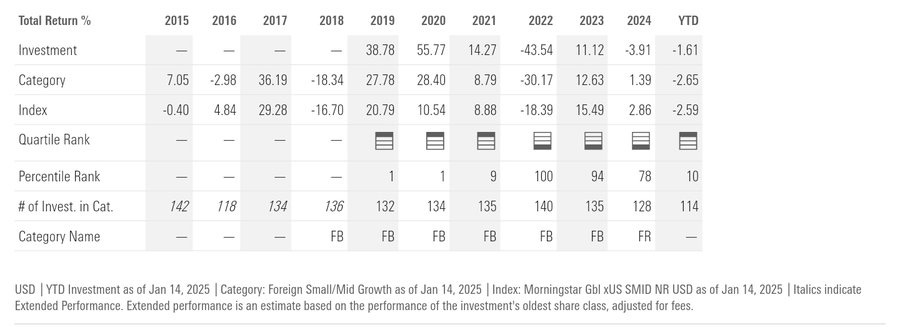
After three years of explosive performance, many growth stocks looked overbought by the summer of 2022. At the time, we sold a number of these highly valued growth stocks including ASML, MELI, MTLS, SEDG to reduce risk. We placed the money in more reasonably priced growth stocks, so-called Growth At a Reasonable Price (GARP) stocks.
We were right to be cautious, but the strategy did not pay off. Overpriced growth stocks indeed got hammered in the second half of 2022, but so did all growth stocks, no matter their valuations. When central banks, faced with galloping inflation, started to tighten monetary policies, a massive rotation into “value” stocks and out of anything that could be considered growth hit the fund very hard. That year, we gave back most of the accumulated outperformance of the previous three years. In most cases, corrections in stock prices were not due to disappointing performance, but solely to a massive derating.
When a company did publish slightly disappointing quarterly numbers, the stock got destroyed as never before. We believe computer-driven sales on any negative news is behind these large movements in stock prices. By the time one wants to introduce a stop-loss, the speed and the magnitude of the correction makes it a moot point.
The Magnificent Seven
For a long time now, large cap US tech stocks have acted as a colossal aspirator sucking global capital and creating a vacuum in most other asset classes. The well-publicized concentration of performance in the US market has been even more staggering when compared to the rest of the world. The Magnificent Seven’s historic performance (AAPL, AMZ, GOOG, MSFT, TSLA, NVDA, META) has led to a combined market capitalization larger than the sum of all European publicly traded companies!*
In the last three years, small- and medium-sized stocks—both domestic and foreign—have been particularly out-of-favor asset classes.
A Strong Dollar
The strength of the dollar has made foreign stocks even less appealing. There was really nowhere to turn to outside of the US. Japanese stocks performed better than their European counterparts in local currency terms. But, this performance has been largely erased for US investors by the weakness of the currency.
The yen lost nearly 50% of its value against the dollar since the fund’s inception in April 2018!** A move of this magnitude can be expected in emerging market currencies. It is unusual for a mature economy that is on the upswing. It is most likely due to the popularity of the carry trade, where hedge funds borrow in yen at a low interest rate and invest the proceed in higher yielding US Treasuries.
Why Go Public?
Europeans don’t trust the stock market. Ownership of stocks is much lower than in the US. It varies from less than 1% in Romania and Bulgaria to a high of 26% of the population in Sweden. Including investments in mutual funds and pension schemes, only 36% of Swedes are exposed to the stock market compared to 62% in the USA.***
This century’s dismal returns overseas is furthermore cooling any enthusiasm from US investors as well, especially in the small- and mid-sized segment. No matter how visionary and hardworking they may be, many European CEOs continue to see their stock as grossly undervalued by the stock market and their companies becoming targets of private equity funds.
Three of the fund’s holdings were thus snapped by Private Equity money. We were forced to let go the German 3D engineering SLM Solutions, the Scandinavian leading pet store chain Musti and Norwegian online education and quiz games Kahoot! This was not surprising. To be frank, we expected more of this. Many neglected stocks in neglected industries in neglected markets offer better risk-reward ratios than most highly valued tech stocks in our opinion. While we realized short term stock price gains, we were deprived of years of performance from those names.
“Kites rise highest against the wind, not with it.” Winston Churchill
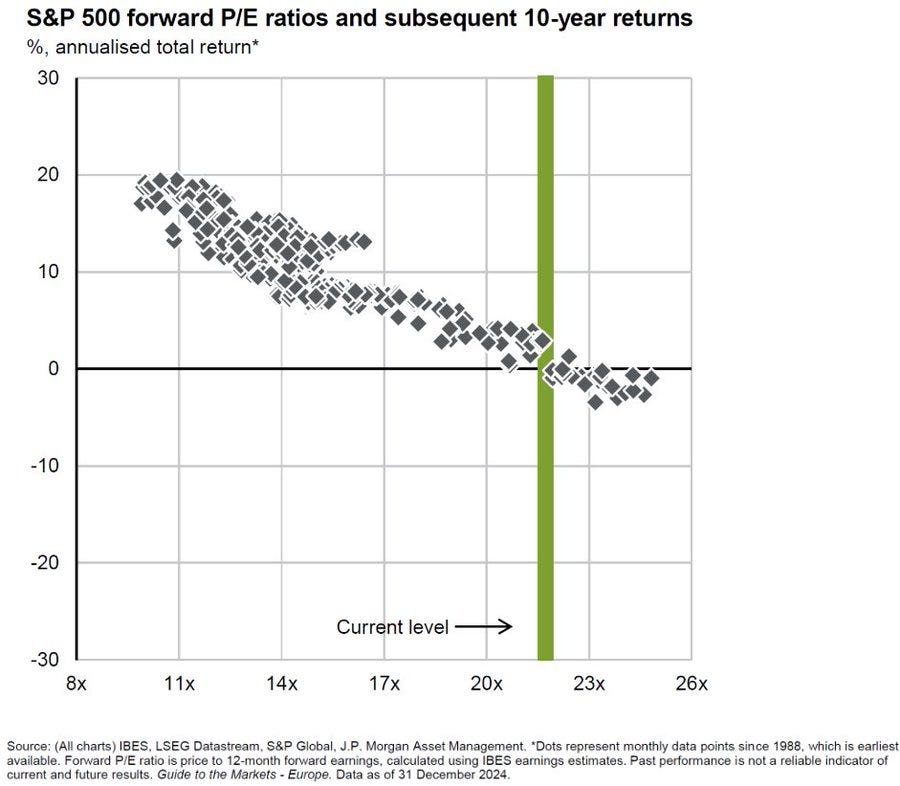
The debate about a possible bubble about to burst rages on platforms like X or LinkedIn. History tells us to be cautious. Transformative technologies create bubbles. The railroads in the nineteenth century, the car industry in the 1920s or the internet at the end of last century have all fueled speculative buying followed by painful corrections.
Investors recognize the importance of the new technology and want to ride the wave. Since it is difficult to know who and how profitable the ultimate winners will be, they accumulate stocks indiscriminately and at any price. At the end of the bubble-burst cycle, only a few companies remain in business. Lots of money is lost in the process. Even Amazon lost 94% of its value before emerging as one of the biggest winners of the internet revolution.****
We are obviously experiencing a similar bubble today with Artificial Intelligence. Is it a bubble ready to burst? Who knows. One thing seems clear from the chart above is that today’s high valuations will likely result in pedestrian returns in the next ten years, either by a slow adjustment or by a sharp correction.
Diversification
Unfortunately, international diversification does not seem obvious either. If one is concerned about a bubble in the US, does it make sense to look abroad? After the historic underperformance of overseas markets since 2008, is this finally the time to take a closer look at foreign stocks? Valuations would definitely suggest it. We also see some encouraging signs of a rising sun in Japan. Europe is at a crossroad. We will soon find out if Europeans will vote for real change.
Is Fundamental Research Still Relevant?
Before we explore opportunities in the coming brave new world, let’s first acknowledge that this is no longer your father’s stock market.
Equity markets have changed greatly over the past decades. The actors are very different. Frequency traders, quant investors together with Artificial Intelligence, index ETFs, industry rotation and "memeification" have all contributed to unprecedented volatility. At times, the markets’ price discovery function seems to have been lost. We believe this is an opportunity for patient investors.
Fundamentals always prevail at the end. Rotation in the art market follows trends. There may be a time when Fauvism is in and Flemish masters out, for example. A painting’s value fluctuates with taste, which changes overtime. Rotation in the stock market makes less sense. Stocks are bought for their discounted dividends, not their beauty. Contrarian investors have made tons of money taking advantage of out-of-favor stocks. However, today’s extreme volatility requires strong conviction and nerves of steel to go against the trend.
In a recent Bloomberg Op-ed titled “I Was a Wall Street Analyst. They Are Irrelevant”, Shuli Ren writes: At the world’s 15 biggest banks, the number of equity analysts has fallen by about 30% from a decade ago, with most cuts in Europe and Asia. Fundamental investing is dying. Algorithms, quants, high frequency trading and other smart programs are the name of the game. Who needs to understand a company’s fundamentals and long term potential when so much money can be made playing the short term rollercoaster?
With all the money going into a small number of US technology companies, interest in international stocks has evaporated. According to Ren, Bureaucracy and banking regulations have steadily eroded the value-add that analysts can provide (…) European lenders, for instance, are subject to the MiFID II regulation that requires asset managers to pay directly for reports that they use.
This puts smaller investment companies at a marked disadvantage, Only large asset managers can afford to pay for independent research. It used to be that sell-side research was rewarded through directing trades and independent research was paid with soft dollars. This may not have been a perfect system, but today’s regulations have resulted in a lack of comprehensive financial research and has added to today’s market concentration. The limited analytical resources are used where there is the most demand—large US tech companies—at the expense of the smaller, less liquid stocks.
As mentioned, this is even more of a problem In Europe, where financial markets are much less efficient and burdened by excessive regulations. On the Old Continent, the financial industry has long been looked at with suspicion and envy. Brokers, traders, investors are perceived to be massively overpaid while contributing little to the economy.
It has gotten worse after the financial crisis of 2008. Politicians blamed overpaid financiers for the debacle. More regulations ensued, including caps on the bonuses employers are allowed to pay their star employees. Europe always solves perceived problems by more regulation and higher taxes. In the process, once again, they shoot themselves in the foot.
Think about it. Brexit seemed to offer a great opportunity for Europe to take market share from the dominant UK financial industry. At the time, many wondered which city would benefit most from the anticipated exodus out of the City of London. Amsterdam, Paris and Frankfurt were prime candidates. However, instead of incentivizing talents to move to their financial capitals, European countries went on a bidding war for who can offer the least attractive financial conditions. The Dutch went so far as to limit year-end bonuses to a maximum 20% of one’s salary. Paris and Frankfurt offer a little more flexibility but still refuse to compete with overall compensation offered by The City of London.
Needless to say, London has thus been able to keep most of its financial influence. However, talented Europeans—including Brits—have only cultural incentives not to move to New York or even Miami.
Today’s markets are testing investors’ conviction and patience more than at any time in my career. Charlie Munger’s advice that the big money is not in the buying and selling, but in the waiting requires something akin to stubbornness when money flows ignore fundamentals.
A Brave New World
The world is bracing itself for Trump 2.0. Some observers watch the unfolding changes with eagerness, but many wait with apprehension. Whatever one’s views, the world economic order as we know it is about to be shaken.
In the East, we have seen some encouraging signs that Japan is turning the page on decades of deflationary stagnation. Japan has furthermore rediscovered the virtues of a vibrant stock market. A new focus on improving return on capital, corporate governance and shareholder return as well as tax benefits for personal savings accounts invested in the stock market have all lead to a reinvigorated stock market. The Japanese economy is finally bouncing back. Inflation has reached 3.6% after decades of deflation and the government is actively promoting wage increases to boost domestic consumption.***** The government is furthermore making public-private capital investments in the semiconductor industry and spending considerably more on defense.
There is another very interesting development here. Not so long ago, Japan was often referred to as the country of robots. There's a cultural fascination with robotics in Japan, stemming from its history in science fiction, like the works of Osamu Tezuka (creator of Astro Boy), and its portrayal in anime and manga. This all seems a bit amusing until one realizes that it may have contributed to better prepare Japan for an aging global population.
Japan may be first, but all developed economies will soon be facing the same problems of a rapidly shrinking workforce and a growing cohort of retirees. It is often said that Japan is in a downward spiral because of its demography. What if this can be turned into an advantage? The willingness to embrace robots in their day-to-day lives could be turned into an economic advantage for Japan. Necessity—and AI—is accelerating the transition to a very different economy.
Elon Musk and Jensen Huang envision a very near future where AI will not only process information, but, more importantly, will interact with the physical world. Self-driving cars and humanoid robots are no longer science fiction.
Self-driving cars will lengthen older people’s mobility. The painful conversation with grandpa to get him to give up his car keys is going to be much easier. Likewise, humanoid robots will prolong older people’s independence by performing all household jobs. Elon Musk believes that the ratio of humanoids to humans will eventually be 3 or 4 to one.
The list of Japanese companies working on humanoid robots is long: Toyota, Honda, Sony, Softbank Robotics, Kawasaki Robotics, Kokoro and more.
Europe Has Reached a Fork in the Road
The European economy has been drifting since the 2008 financial crisis. That year, Germany’s nominal GDP per capita was not far behind the US, $43,230 versus America’s $48,590. Sixteen years later, Germany’s number has barely grown to $55,520 whereas the gross domestic product per person in the US has surged to $86,600. After sixteen years of economic mismanagement, France’s performance is even more appalling with nominal GDP per capita bumping from $45,300 in 2008 to a projected pitiful $47,300 last year.******
Something went very wrong in Europe. Germany may want to reflect on the following: German industrial output has fallen by 5% since 2011, while Swiss industrial output has risen by 40%. The Swiss franc has appreciated by 25% against the euro, greatly revaluing the savings of the Swiss people. Swiss interest rates peaked at 1.75%.
Germans may well regret abandoning the once mighty Deutsche Mark. The independent Swiss have not forgotten what Germany used to preach. A strong currency promotes virtue and pushes companies to focus on adding value.
A Wake Up Call
The new US administration’s aggressive policies could be the wake up call Europeans need. If Europe does not want to become a mere destination for rich American and Asian tourists, they will need to embrace the winds of deregulation coming from the New World. It has happened before. The Reagan revolution in the 1980s inspired the creation of a free market in Europe.
It resulted in the 1992 Treaty of Maastricht, which laid the foundation for the Euro as well as the free flow of capital, goods, people and services within the newly created European Union. This was supposed to make the European economies more competitive by creating a large market and submitting formerly protected national industries to open competition within Fortress Europe.
Countries in the EU now had to compete for businesses by creating the most business friendly environment. One obvious way to do this was by lowering taxes.
There was a palpable, renewed optimism in the 1990s. The European economy was doing well and stock markets generated great returns. The future was bright. Eurosclerosis had been defeated. And what did politicians do? Give Brussels bureaucrats more power.
A weak political generation followed the architects of the treaty of Maastricht. National leaders let Eurocrats in Brussels hijack Europe’s ambitious economic project. Instead of more deregulation, Eurocrats created another big layer of laws and rules. No doubt Margaret Thatcher and even Jacques Delors are spinning in their graves.
Now comes Trump. Whatever one thinks of him, he may be the best thing that happened to Europe in a long time. Trump’s aggressive policies are forcing Europeans to face reality. Be it with NATO or with what we used to call Fortress Europe, the Old Continent cannot forever rely on American protection while at the same time protect its markets from American imports.
Europe cannot remain passive. The question is how will Europe react? The risk of a trade war is real. Europe has to make a simple choice between more protectionism and becoming more competitive.
The coming elections in Germany will set the tone. The outgoing coalition of Social Democrats and the Green Party are expected to lose big. Polls indicate a willingness to put parties in charge that will embrace more business friendly policies in order to better compete with their American counterparts.
A new generation of politicians needs to take back the excessive power given to the unelected eurocrats in Brussels.
What do we know so far?
Some of the big changes that can be expected include:
- The cost of energy is likely to come down due to the new administration's "drill baby drill" policies and will fall even more if there is peace in the Middle East and Ukraine. Both Japan, which imports all its oil, and Europe will be major beneficiaries.
- Higher defense spending will be a feature. Japan has already boosted their national defense budget to 1.6% of GDP and 7% of the national budget.******* The push to have NATO countries to pay more for their defense is gaining momentum. The invasion of Ukraine has changed public opinion dramatically in Europe. The ramifications for technology are not to be dismissed. So much of technology innovation comes from military applications.
- Tariffs and de-globalization requires new massive capex for the repatriation or the relocation of industries. China is the major loser in this reorganization of global supply chains.
- With the rapid expansion of AI, the need for electric infrastructure is huge. Some of the large suppliers are in Japan (Hitachi, etc) and Europe (Schneider and even Siemens).
What will Trigger Renewed Interest in International Markets?
Will 2025 be the year investors rediscover foreign stocks? Will overseas GARP stocks make their return? There sure is a lot of upside from today’s low valuations.
International investments have never been so out of favor in the 40 years of my career. A typical allocation of foreign stocks used to be 15%. I doubt most portfolios are close to that level. It feels as if we have reached a capitulation phase, which is often a good time to buy.
Just as Japan could do no wrong in the 1980s—until it crashed spectacularly—the US economy is thriving and looks unbeatable. However, valuations may be getting ahead of fundamentals. At any rate, little attention is being paid to successful companies overseas. In ordinary investment environments, it would be time to look for neglected stocks. We couldn’t even call this move contrarian investment because these companies are delivering great numbers.
—
*Goldman Sachs Research
**World Bank Open Data
***Journal of Banking and Finance, Volume 148, March 2023
****Bloomberg
*****Bloomberg
******World Bank Open Data
*******Nippon
The views and opinions expressed are for informational and educational purposes only as of the date of production/writing and may change without notice at any time based on numerous factors, such as market or other conditions, legal and regulatory developments, additional risks and uncertainties, and may not come to pass. This material may contain “forward-looking” information that is not purely historical in nature. Such information may include, among other things, projections, forecasts, estimates of market returns, and proposed or expected portfolio composition. Any changes to assumptions that may have been made in preparing this material could have a material impact on the information presented herein by way of example. Past performance is no guarantee of future results. Investing involves risk; principal loss is possible.
All information has been obtained from sources believed to be reliable, but its accuracy is not guaranteed.